
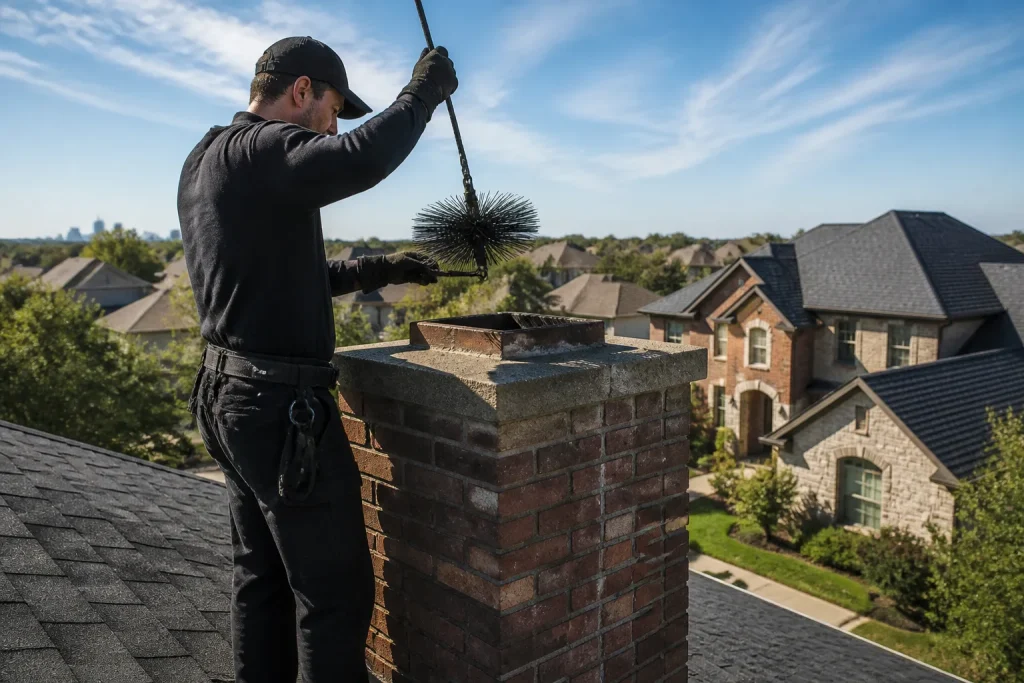
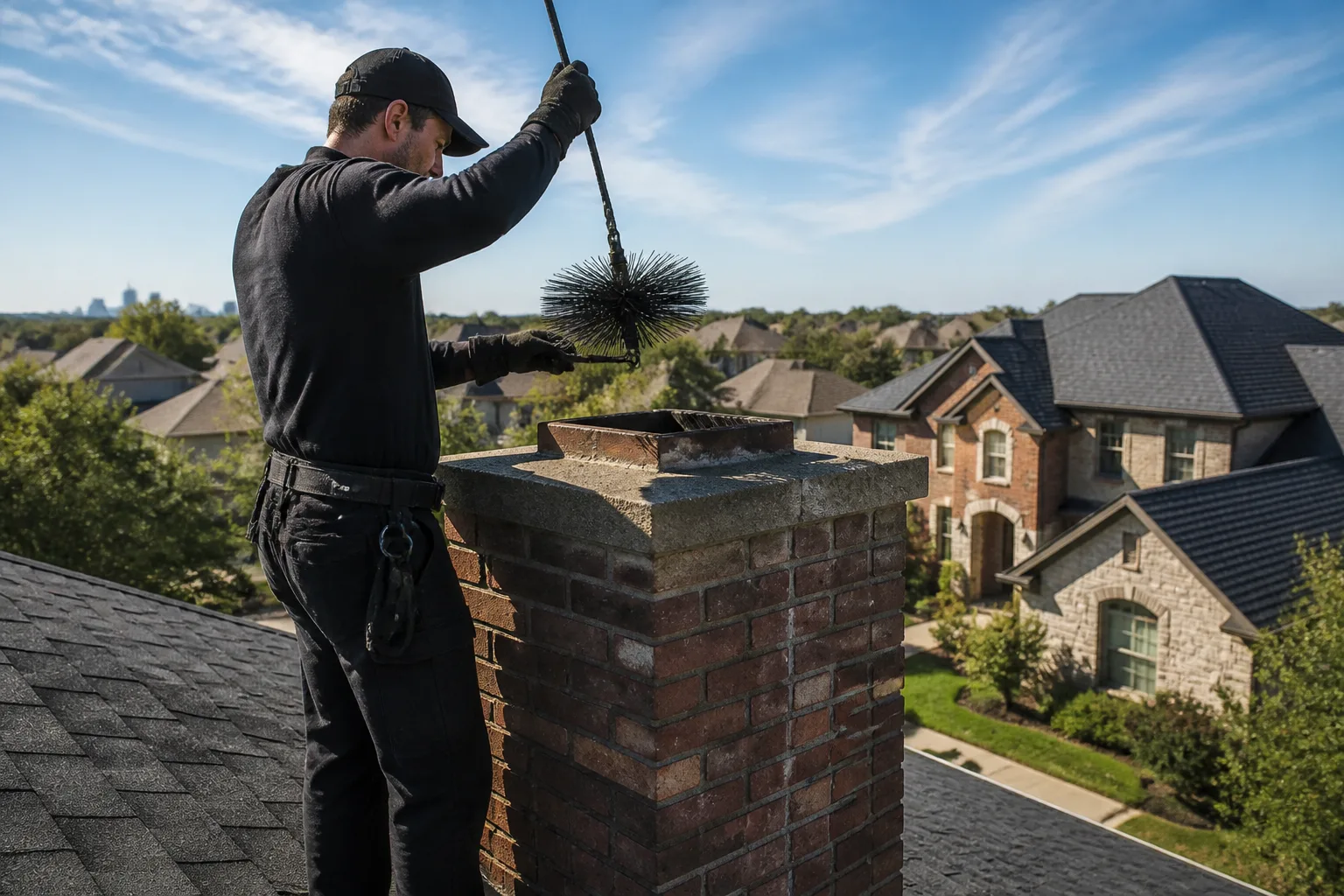
DuraFlex Chimney Sweep in Westchase: A Homeowner’s Guide
A DuraFlex liner that was never sized to your appliance won’t draft correctly, even if the material itself is flawless. That single mistake is behind a lot of the smoking fireplaces and damp flues we’re called out to look at around Westchase. And in our humid, hot-and-cool climate, a weak draft turns into a moisture problem quickly. This guide explains what DuraFlex is, why it suits Westchase homes, and how to tell whether an installation was done right. If you’d rather skip the detective work and get a straight answer, call (844) 443-3785.
What is a DuraFlex chimney liner, and why do Westchase homes use one?
DuraFlex is a flexible stainless steel liner system used to reline masonry chimneys. It’s a continuous length of corrugated stainless steel that runs from the top of the chimney down to the appliance, and it’s specified over rigid stainless when a flue has offsets, bends, or a shape a straight pipe can’t follow. That flexibility is the whole point. Many older masonry chimneys in Westchase were built with a jog or a slight angle in the flue, and a rigid liner simply won’t pass through without cutting and joining sections.
Here’s what makes it worth understanding before you book anyone:
- It handles non-standard flues. Offsets, bends, and irregular cross-sections that make rigid installers walk away are exactly where DuraFlex earns its place.
- It’s a sealed, continuous path. The flue gases travel inside the liner, not against aging mortar and brick.
- It protects the chimney structure. A liner keeps corrosive byproducts off the masonry, which matters in a climate that already works on your chimney with heat and humidity.
We install and work with DuraFlex systems as part of our full-system chimney care, and we source materials from established trade suppliers like Olympia Chimney. The brand isn’t the guarantee. The installation is.
Why does Houston-area humidity stress a liner system?
Westchase sits in a climate that swings between hot, humid summers and mild winters, and that cycle is hard on a chimney. Heat drives moisture into masonry, and the cooler months let it condense on cold surfaces. A liner is your barrier against that moisture reaching the brick and mortar. But the barrier only works if it’s seamless and properly insulated.
This is where a flexible liner’s construction matters. A continuous length has no mid-flue joints for moisture and creosote to work into. Segmented or sectional alternatives introduce seams, and every seam is a place where condensation can collect and corrosion can start. In a Westchase home, where the flue may sit unused for months and then run hard through the cooler season, that difference adds up over time.
We’ve seen liners that looked fine from the hearth but were quietly trapping moisture behind a poor top seal. A liner’s job in this climate is two-fold: carry the exhaust out, and keep the weather and condensation off the masonry. When either half fails, you find out through a damp smell, a stubborn draft, or staining on the chimney exterior.
What does correct DuraFlex sizing actually involve?
Correct sizing starts with a calculation, not a guess. The liner has to match the appliance. A flue that’s too large for the appliance cools the exhaust before it exits, which weakens draft and invites condensation. A flue that’s too small chokes the appliance and restricts how it burns. Either way, the material can be perfect and the chimney still won’t perform.
A proper sizing and installation plan covers:
- BTU-to-flue-diameter calculation. The appliance’s output and type determine the liner diameter the flue needs. This is a number, not an eyeball estimate.
- Appliance matching. A wood fireplace, a wood stove, and a gas appliance each have different venting requirements. The liner is chosen to fit the appliance it serves.
- Top termination. The liner has to be capped and sealed at the top with a proper plate so rain and animals stay out and the connection is airtight.
- Bottom termination. The connection at the appliance end needs the right adapter so the liner meets the firebox or insert cleanly, with no gaps.
When we inspect what we sweep, sizing is one of the first things we check, because a beautiful liner installed at the wrong diameter is still a problem waiting to surface. For the wider system around it, our chimney sweep covers the cleaning and assessment side, while the liner and flue work fall under chimney repair.
What are the red flags of a bad DuraFlex installation?
The most common installation failures are invisible from the living room. A liner can be the right brand, the right length, and still be installed in a way that shortens its life and undermines your draft. Watch for these:
- No insulation wrap. An unwrapped liner loses heat to the cold masonry, which weakens draft and encourages condensation. Insulation is part of doing the job properly, not an upsell.
- Improper top plate sealing. If the top plate isn’t sealed correctly, water gets in around the liner and travels down behind it. That’s a moisture problem you won’t see until it’s done damage.
- Connections made without proper adapters. A liner joined to the appliance with a makeshift connection leaves gaps that leak exhaust and disturb draft.
- No sizing documentation. If nobody can tell you what diameter was specified and why, the sizing was likely a guess.
In our experience, the top plate is where more shortcuts hide than anywhere else. It’s out of sight, and a rushed seal there is easy to miss from the ground. It’s also the first thing we check on a post-install review in Westchase, because that’s where weather gets its opening.
How can you verify a completed DuraFlex installation?
Ask for documentation and then confirm it with an inspection. You don’t need to climb the roof to know whether the job was done right. A few targeted questions and a proper post-install inspection will tell you most of what you need.
What to ask for:
- The specified liner diameter and the sizing basis behind it.
- Confirmation that the liner was insulated along its full length.
- A description of how the top plate was sealed and how the bottom connection was adapted.
- A post-install inspection report, ideally with photos, confirming the liner is continuous and correctly terminated at both ends.
A post-install inspection should confirm the liner runs without breaks, both terminations are sealed, and the appliance draws as it should. If a contractor can’t produce that, or waves off the questions, treat it as a reason to look closer. A proper chimney cap & crown check belongs in the same visit, since the top of the system is where the liner meets the weather. The documentation should stand on its own; if it doesn’t, ask why.
When should you call a specialist?
Call a specialist when a fireplace smokes into the room, when you smell a damp or sooty odor on mild days, when you’ve been told you need a reline but haven’t seen the evidence, or when an appliance just won’t draft the way it used to. Those are signs the liner or the flue around it needs a real diagnosis, not a guess.
A DuraFlex reline is a job for a chimney specialist, not a generalist. The sizing, the insulation, and the terminations all have to be right together, and a mistake at any step shows up later as poor performance. If your fireplace or firebox needs attention alongside the liner, our fireplace repair handles that side of the system, so the whole chimney gets looked at in one pass rather than piecemeal. One call, one diagnosis, from firebox to chimney cap.
Related services in Westchase: chimney sweeping, inspection, cap and crown work, fireplace repair, and chimney repair. If you suspect a liner issue, start with a Chimney Sweep Westchase and we’ll assess the full system before recommending anything.
The Bottom Line
DuraFlex is a genuinely durable liner solution for Westchase homes with aging masonry chimneys, and its flexibility is what lets it handle the offsets and bends that stop rigid installers. But the material is only half the story. Correct sizing, full-length insulation, sealed terminations, and proper adapters are what make it perform in our humid climate. If a contractor can’t explain those steps or hand you the documentation, that’s your signal.
We work with DuraFlex systems and HeatShield liner restoration as part of full-system chimney care, and we inspect what we sweep so you get an assessment, not just a cleaning. Our technicians have up to 9 years of experience. Nothing gets recommended without evidence you can see for yourself. If you’re in Westchase and need help, Chimney Sweep Westchase offers free estimates. Call (844) 443-3785. We answer 24/7. Fast dispatch from 7am to 7pm, Sunday through Friday.
Frequently Asked Questions
Neither is universally better; the flue decides. DuraFlex is the better choice when a masonry chimney has offsets, bends, or an irregular flue that a rigid liner can’t pass through without being cut into sections. For a straight, standard flue, a rigid liner can work well. The right pick depends on your chimney’s shape and your appliance, which is why an inspection comes first. Call (844) 443-3785 for an exact quote; estimates are free.
Ask for the specified diameter and sizing basis, confirmation the liner was insulated, a description of how the top plate was sealed, and a post-install inspection with photos. Then verify the liner is continuous and both ends are sealed. If the documentation is missing or vague, get a second look. Call (844) 443-3785 to book an inspection.
Usually it’s sizing or draft. A liner that’s too large for the appliance cools the exhaust and weakens draft, and an uninsulated liner loses heat to the masonry. A poor top seal can also let in moisture that disrupts draft. In Westchase’s humidity, that shows up fast. Call (844) 443-3785 and we’ll diagnose the cause before recommending work.
It depends on how much you burn, but many homeowners have the chimney swept and inspected once a year, and more often with heavy use. A liner doesn’t remove the need for sweeping; creosote still builds up on its inner surface. Annual service also catches small liner or cap problems early. Call (844) 443-3785 to schedule a sweep and inspection.
Written by the team at Chimney Sweep Westchase.
Need Chimney Cleaning Help?
Call Chimney Sweep Westchase - the local pro we connect you with is licensed and insured, with free written estimates in Westchase.
(844) 443-3785